A campaign button looks like the simplest thing you will ever order, which is exactly why so many first orders go wrong. The text runs too close to the edge and gets swallowed by the rim, the photo pixelates at three inches, or a volunteer prints a thousand at a size nobody wants to wear. None of that is hard to avoid once you know how a button is actually built and what the printer needs from you. This is the practical walkthrough, from picking a size to the one legal question campaigns always ask.
Start with the size, because it sets everything else
Pinback buttons come in a small set of standard diameters, and the choice is not just aesthetic. The common rounds are 1 inch, 1.25 inch, 1.5 inch, 2.25 inch, and 3 inch, with oversized 6 inch display buttons for tables and rallies. For campaigns, the 2.25 inch round is the long-standing standard; it is large enough to carry a name and a simple logo legibly, small enough to wear comfortably on a lapel, and it is what most supporters expect a campaign button to look like. The 1 inch and 1.25 inch sizes are cheaper and popular for bulk giveaways and merch tables, but they force you to a logo or a single short word. The 3 inch is the right call when you want a photo or a two-line message to read across a room. Pick the smallest size that comfortably holds your message, then design to that size specifically.
Design inside the safe area, or lose your text to the rim
The mistake that ruins more button artwork than any other is treating the finished diameter as the usable space. It is not. A button is made by wrapping a printed disc over a metal shell, so a ring around the outside edge curves down and around the rim where it is hard to read or partly hidden. Printers account for this with two zones: a bleed, usually about one-eighth of an inch, that extends your background past the cut line so no white edge shows, and a safe area, set in from the edge, where all text and important elements must stay. The gap between them is real, and it is bigger than people expect.
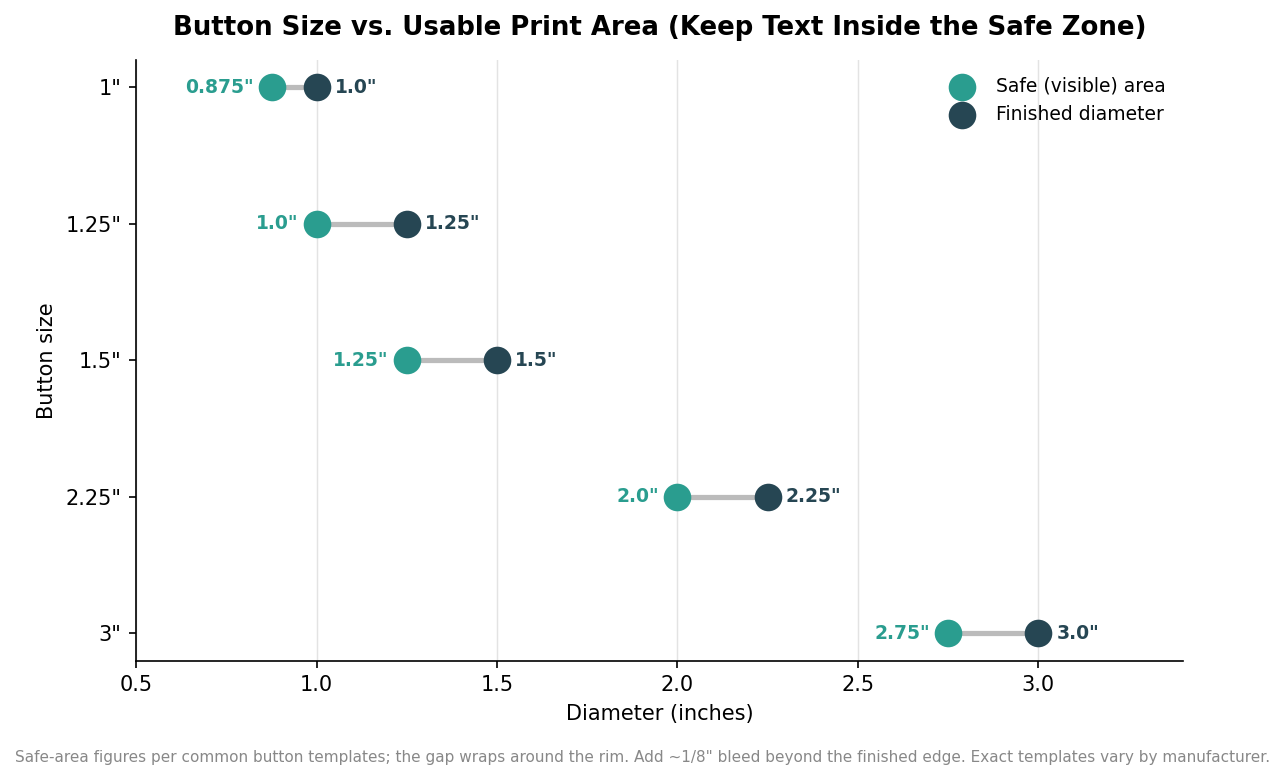
On a 2.25 inch button, the safe area is only about 2.0 inches across; on a 1 inch button it is roughly 0.875 inches. That means a 2.25 inch button gives you a two-inch canvas for anything that has to be readable, and everything outside it should be background you are willing to lose to the wrap. Build your file at 300 DPI, extend the background to the full bleed, keep the candidate name and any URL comfortably inside the safe circle, and avoid thin borders that ring the edge, because a border is the one design element guaranteed to look crooked once it wraps. Exact template sizes vary slightly by manufacturer, so download the printer’s template for your chosen size rather than guessing.
Order the right quantity, because the price curve is steep then flat
Buttons are cheap to make and cheaper in bulk, but the savings are front-loaded. The per-button price drops sharply from small runs to a few hundred, then flattens out, so the money question is usually not how low can I go but how many will I actually hand out. As an indicative example, one US vendor’s published 2026 tiers for a 2.25 inch full-color button run about $0.51 each at 50, around $0.41 at 100, roughly $0.39 at 500, and near $0.31 at 10,000. The shape of that curve is the point.
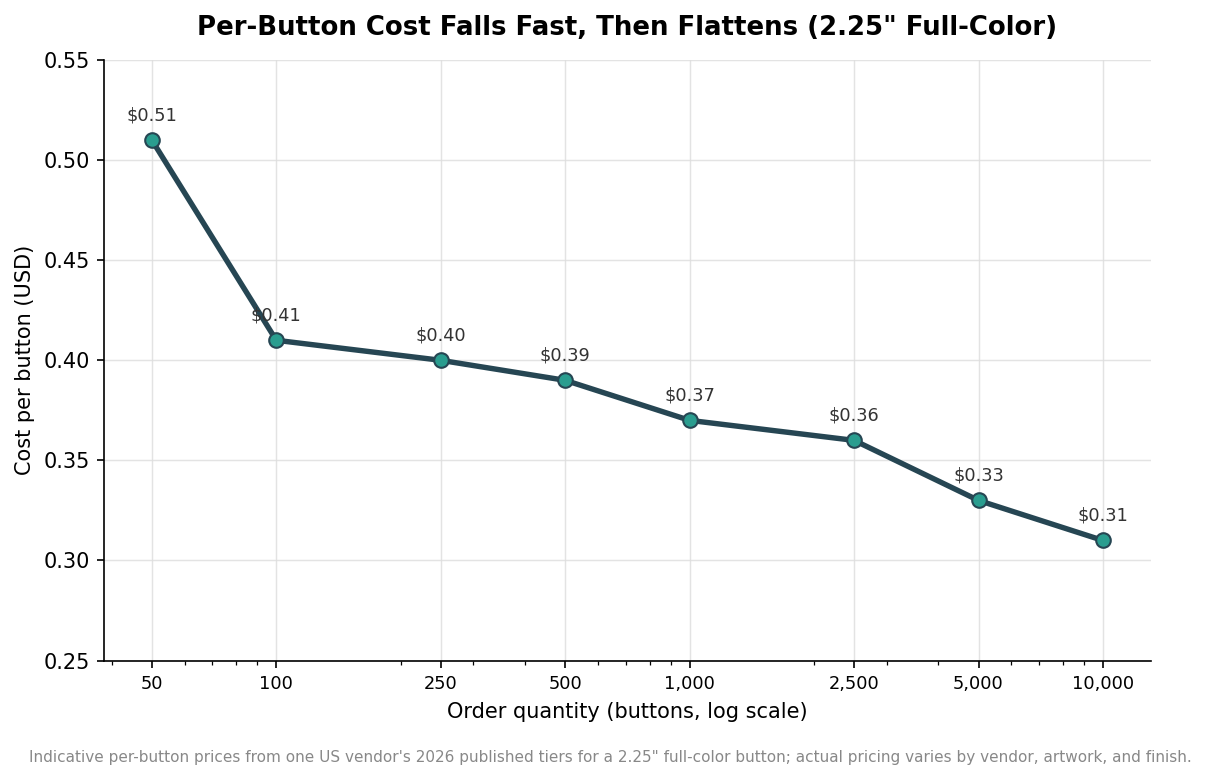
Read practically, the chart says that jumping from 50 to 500 buttons cuts your unit cost by about a quarter, while going from 5,000 to 10,000 barely moves it. For most local and regional campaigns, ordering in the few-hundred to low-thousands range captures nearly all the bulk discount without leaving boxes of buttons in a closet after election day. If you expect multiple waves, such as a primary run and a general run, it is often smarter to reorder than to over-buy up front, since artwork can change and a dated button is a wasted button. These figures are one vendor’s example and will vary with artwork, finish, and supplier, so treat them as the pattern rather than a quote.
The disclaimer question: buttons are usually exempt
Every federal campaign eventually asks whether the button needs a “paid for by” disclaimer, the notice required on most campaign advertising. For buttons, the answer under federal rules is generally no. The FEC’s disclaimer regulation contains a small-items exemption for materials where a disclaimer cannot be conveniently printed, and it names the category directly, listing “pens, bumper stickers, campaign pins, campaign buttons and similar small items” as examples. A separate exemption covers items where display is impracticable, such as wearing apparel and skywriting. In plain terms, a standard campaign button does not have to carry the “paid for by” line, which is part of why designers can use the whole face for the message.
Two cautions belong with that. First, the exemption is about federal law under the FEC; state and local election authorities set their own rules, and a few have different requirements, so a campaign should confirm its own jurisdiction’s rules rather than assume the federal exemption controls everywhere. This is general information, not legal advice, and anything with real stakes is worth a quick check with your campaign counsel or compliance staff. Second, the exemption removes an obligation, not an option: if you want to include a small disclaimer or a union bug for transparency, nothing stops you, as long as it stays inside the safe area with everything else. Spec the size to the message, design inside the safe circle, order the quantity you will actually use, and confirm your local rules, and the simplest thing you will order will also be the one that comes back exactly right.