Two questions come up on almost every campaign button order, and both have answers that surprise first-time buyers. The first is whether the button needs a “paid for by” disclaimer like a mailer or a yard sign. The second is whether it needs a union bug, the little printer’s mark you see tucked at the edge of political materials. The short version is that federal rules usually exempt the button itself from a disclaimer, and the union bug is a labor and party expectation rather than a printing law. The longer version is worth understanding before you approve artwork, because the exemption that frees your buttons does not free the rest of your program. This is general information, not legal advice; confirm specifics for your race with counsel or your state election office.
The small-items exception: why a button usually carries no disclaimer
Federal election rules require a “paid for by” disclaimer on most public communications a political committee pays for, but they carve out an explicit exception for objects where a disclaimer cannot be conveniently printed. The Federal Election Commission names the category directly, listing “pens, bumper stickers, campaign pins, campaign buttons and similar small items” as exempt. There is a companion exception for communications where a disclaimer would be impracticable, which the rules illustrate with examples as varied as wearing apparel, water towers, and skywriting. The logic is physical, not political: on a small round button there is no room for a legible funding line without crowding out the message.
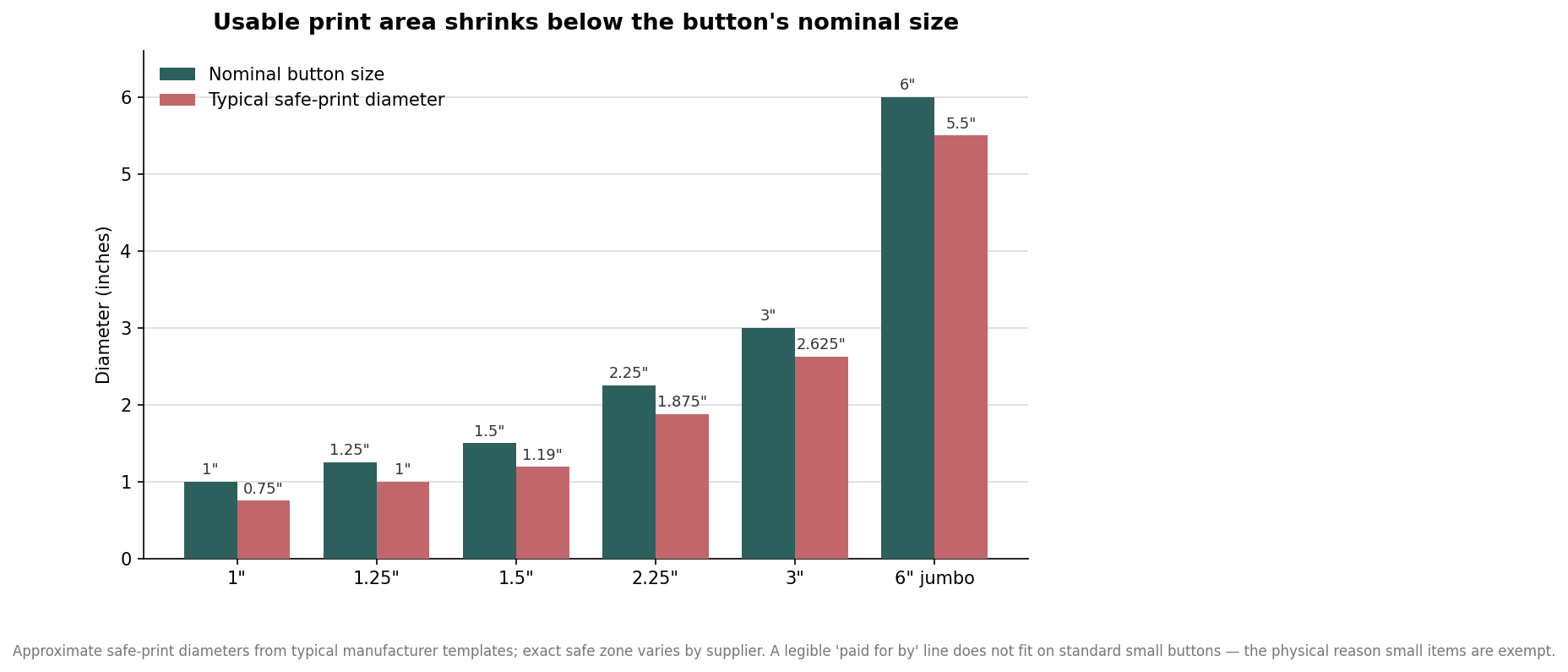
The numbers make the exemption obvious. A button’s usable print area sits meaningfully inside its nominal diameter because the graphic has to wrap around the rolled edge, and the safe zone where text stays sharp is smaller still. On a one-inch or 1.25-inch button, the safe area is roughly three-quarters of an inch to an inch across, which is barely enough for a name and an office, let alone a committee’s full legal name and a “paid for by” line at readable size. That is exactly the situation the small-items exception was written for. It is why you can order a clean two-word button without a disclaimer and stay within federal rules.
What still needs a disclaimer, even when your buttons do not
The exemption is narrow. It covers the small item, not your whole outreach program, and campaigns get into trouble by assuming the button rule extends to everything else. Federal disclaimers attach to communications made in volume or to the public: a mass mailing, defined as more than 500 substantially similar pieces within 30 days, a phone bank of more than 500 similar calls in 30 days, and email programs of more than 500 substantially similar messages. Broadcast, cable, outdoor advertising, and paid public-facing digital ads require a disclaimer regardless of how many run.
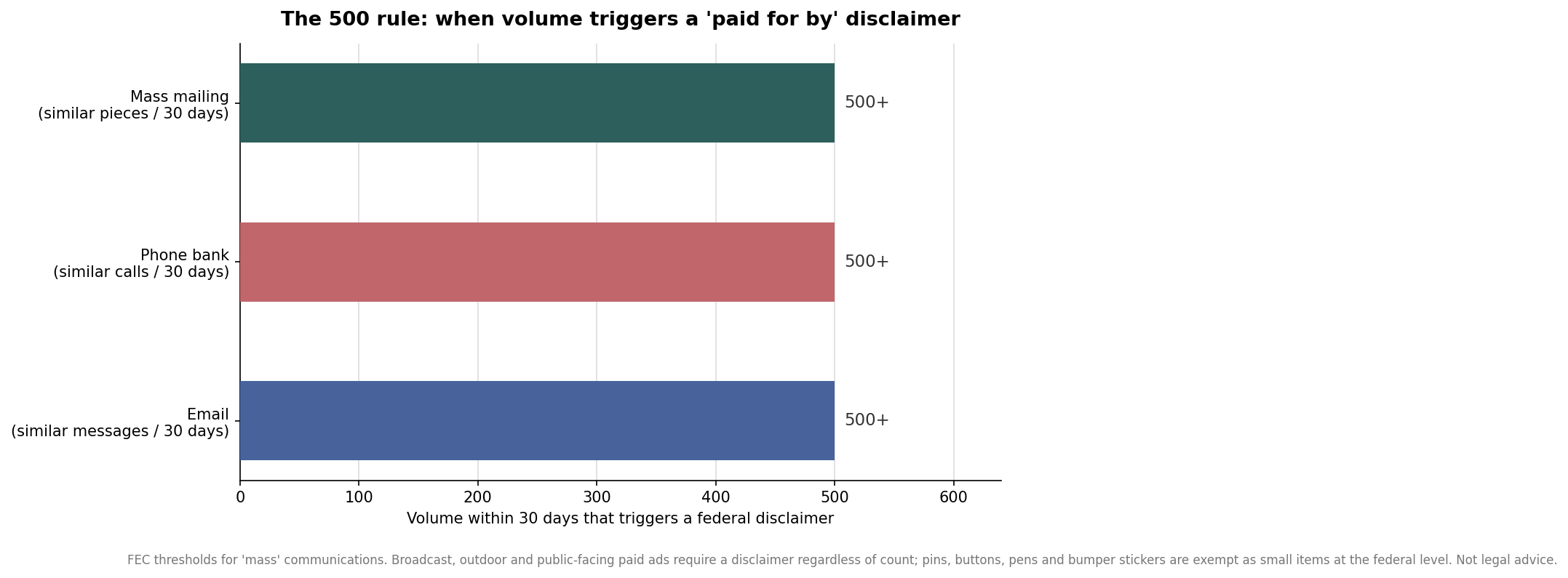
So the practical boundary is this: your pin-back buttons, pens, and bumper stickers can go out clean, but the postcard you mail to announce the rally, the robocall inviting people to it, and the boosted social post all carry the funding line. Treating the button exemption as blanket permission is one of the more common and avoidable compliance slips.
The disclaimer wording that governs the rest of your materials
Where a disclaimer is required, the wording follows a fixed pattern tied to who paid and who authorized the communication. A message paid for and authorized by the candidate’s own committee reads simply, in the form “Paid for by the Sam Jones for Congress Committee.” A message authorized by the campaign but paid for by someone else adds the authorization, as in “Paid for by the XYZ Committee and authorized by the Sam Jones for Congress Committee.” A message that the candidate did not authorize must say so and identify the payer with contact information, in the form “Paid for by the Court Jesters Union PAC and not authorized by any candidate or candidate’s committee.” Every required disclaimer has to be clear and conspicuous, whatever the medium. None of that has to appear on the button, but it should appear, correctly, on the materials that are not exempt.
The union bug is a different question entirely
A union bug is a small printed symbol certifying that a product was produced by union labor. It is not a federal election requirement and it is not a printing law in the general case. It functions as a signal to labor-aligned audiences and, for many Democratic and union-endorsed campaigns, as an expectation attached to endorsements and to certain contracts. Where it is genuinely required tends to be specific: union-commissioned work, some government contracts whose bidding rules mandate union printing, and campaigns whose labor backing comes with a condition that printed materials carry the mark. Plenty of organizations also choose union printing voluntarily for the credibility it carries with those audiences.
Only certified union shops may apply a bug, and the marks are issued through recognized unions such as the Graphic Communications Conference of the Teamsters, the Communications Workers of America, and, for some trades, the International Union of Painters and Allied Trades. A printer cannot simply add the symbol; using one without certification invites real consequences. For buttons specifically, a union bug is usually a matter of whether your endorsement or your party’s expectations call for it, not whether the law does. If a labor endorsement is in play, ask early, because it constrains which shop can produce the run.
How to order so compliance is not an afterthought
Decide two things before you approve artwork. First, confirm whether any material in the order is not a small item, and make sure those pieces carry the correct disclaimer in the right form. Second, ask whether a union bug is expected for your race, and if so, specify it on the order and confirm the shop is certified to apply it, since that decision narrows your vendor options and can affect lead time. Keep the button face itself focused on the message and legible at a glance; the exemption exists precisely because fine print does not belong there. Where a rule here is stated in general terms, treat it as a starting point rather than a ruling on your situation. Federal law is only one layer, state and local election codes add their own requirements, and the safe move on any close call is a quick check with your compliance counsel or state election office before the run goes to print.